LIFT + LOVE BLOG
What do you do when church leaders give talks that are painful?
Acknowledge and honor your pain. It’s okay to acknowledge that church leaders said something that caused you pain. And it’s important to allow yourself to feel it without judgment. Sometimes, as members of the church, we think that in order to be “all in” the gospel we need to be 100% behind what every church leader says from every pulpit. That is simply not true.
Acknowledge and honor your pain.
It’s okay to acknowledge that church leaders said something that caused you pain. And it’s important to allow yourself to feel it without judgment. Sometimes, as members of the church, we think that in order to be “all in” the gospel we need to be 100% behind what every church leader says from every pulpit. That is simply not true.
Give yourself time to process
Sometimes the best way to process something is to let it fall to the back of your mind for a while. It’s not going to go away, but it doesn’t have to consume all of your attention. If the talk was given during General Conference, focus on the talks that were healing, uplifting, or inspiring. Give your mind and your heart time to come to terms with the words and the manner in which they were said.
Avoid making big decisions in the middle of the pain
It can be tempting to react or make big decisions when we are reeling from a painful talk. These could be decisions about church or family relationships. But we don’t have to be reactive. Wait to make big decisions until you feel like you can come from a place of love, not hurt or anger.
Seek understanding
Author Doe Zantamata wrote, “It’s easy to judge. It’s more difficult to understand. Understanding requires compassion, patience, and a willingness to believe that good hearts sometimes choose poor methods. Through judging we separate. Through understanding, we grow.” Understanding often requires us to look past the words that were said to the person who spoke them. It may require us to move closer, not distance ourselves from them. If you don’t feel safe enough or ready to move closer, you can take a step back instead. Try to see the bigger picture of their words over time. Read some of their other talks about different topics, or even review other sections of the talk they gave that was painful. Try to see who they are and how they have shown love in situations not relating to this particular pain point…
Extend grace
Extending grace doesn’t mean we have to be okay with what someone says (or the manner in which they say it). It means that we strive to withhold judgment or condemnation of the person behind the words. It means acknowledging that they are mortal and flawed and imperfect – just like us. It means giving them the benefit of the doubt and assuming goodwill when possible. And sometimes it also means recognizing that they may continue to say things that are hurtful and giving yourself permission to avoid those situations.
Focus on the Savior
The leaders of the church may be called to serve and represent the Lord, but they are not Him. More than anyone else who has lived on this earth, the Savior knows our pain and can comfort us in our sorrows. His love is pure and unconditional and healing. When we feel the Savior’s affirming love in our lives, it can give us the strength to keep pressing forward on the path He wants us to travel. Hold fast to the Savior and don't let go. He is our Advocate in every sense of the word.
-Anita

WEDDINGS
I hear about so many members who question if they should go and support the weddings of their LGBTQ family or friends…

This was the happiest and most important day we have shared as a family.
The wedding of Devin and Jake was literally full of loved ones who flew from all over the world to celebrate their marriage. It was a perfect day.
Many of the people pictured here are not active members of the Church of Jesus Christ of Latter-day Saints, and some are not members at all. WHAT IF they had purposefully not come to the wedding because they didn’t want anyone to think they approved of where (or how) the happy couple were getting married?
I hear about so many members who question if they should go and support the weddings of their LGBTQ family or friends.
What if some of these people in this wedding photo had decided not to come to this traditional LDS temple wedding because they were worried about the message their attendance would send? Was their attendance ever interpreted by us to mean that they agree with our beliefs and where the marriage was taking place? Or did it simply mean that they love my family? Without each of them, would this photo still be a reminder of a perfect day, or would the holes of those missing loved ones forever remind us of those who stayed away because of differences in beliefs?
I am grateful for those, not of our faith tradition, who waited on the grounds of the temple as my baby was sealed to her honey inside, and then joined us on those gorgeous stairs for a priceless memory of our greatest day ever - Allison

Why do our brains like to worry?
When my son came out I worried. I worried a lot and about everything. I was eating worry for breakfast, lunch, and dinner.

I recently had to go to the dentist. I really love my dentist but I HATE going to the dentist. We have been at this same practice for 10 years. They know all of our children so well that they almost feel like family friends.
HGTV was on the tv and I when he walked in I joked that watching this all day must make for a lot of house projects for him. He laughed, but said "really we have it on all day because this is one of the only “safe” channels out there." I looked perplexed, so he then added – “you know even the cartoon channel isn’t safe and this one is becoming unsafe too. Every show now has two guys sitting on a coach holding hands – the token gay couple.”
I was so flabbergasted that I am ashamed to say that I didn’t even respond. Which makes me feel shame that I didn’t take the time to educate him how hurtful those words are.
But I did feel sad. Sad that this is what our LGBTQ community faces everywhere they go – even at the dentist – marginalized thinking which leads to marginalized treatment. Here was a man that we love and respect and had no idea he thought this way.
When my son first came out my mind would have gone straight to worry. Worry about all the possibilities how my son could get hurt. Worry that not even the dentist could be a safe place for him.
But worry is an indulging emotion that brings no returns. Worrying doesn’t help my son or myself.
Why does our brain try to convince us Worry is necessary?
Because we don’t like to feel helpless and there is a lot you feel helpless about, especially when your child is LGBTQ.
So our brains worry to try to gain back some control. It tells us the story that worry is necessary because at least we are taking action.
This is a lie.
Erma Bombeck said it best - “Worry is like a rocking chair: it gives you something to do but never gets you anywhere”
Worry appears to be necessary but I promise, it never changes the impact of the thing you are worrying about. Your brain will try to sell you that worry is necessary but this is a lie.
When my son came out I worried. I worried a lot and about everything. I was eating worry for breakfast, lunch, and dinner. You can imagine my indigestion and weight gain!
I felt like in order to be a good parent worry was necessary and important.
The result of all my worry was a disconnected, distracted, fearful mama. My parenting decisions were made from fear and worry, which made for a lot of parenting mistakes.
My worry wasn’t solving anything and in fact, it was causing more problems.
Then one day my life changed when I was working with my coach and I was telling her about how I was so worried about something that my son might do.
She asked me “Why was I worried?” I didn’t understand her question. I didn’t believe there was any other way to feel about it. I thought it was a dumb question because it was pretty obvious why I should be worried.
Then she offered me one of my favorite questions– it changed my relationship with worry.
She asked me "how was my worrying helping my son?"
Asking myself that question made me realize worrying was the opposite of helping. In fact, it was hurting my ability to help him by taking away my energy and blocking my creativity from actually helping him.
I couldn’t give her one useful answer for why my worry was necessary. I finally saw worry for what it was. A joy stealer. A manipulator of my positive emotions.
I was making parenting decisions from fear which really resulted in me trying to manipulate and control his actions so I could feel less worry.
My worry was coming from my mindset of something had gone wrong and I needed to solve the problem.
I was wrong. I needed to stop wasting my energy on things that were out of my control and instead I needed to focus on what I could control - who I wanted to be in this story.
I was telling myself that if I worry then it might prevent him from making bad choices. I needed to own up to the fact that his choices weren’t creating all of my negative emotion, I was.
This is the moment when I got my power back and I realized worry is ALWAYS optional and never necessary.
When worry tries to steal my energy I have learned to remind myself that being afraid of things going wrong isn’t the way for things to go right.
So how do you break the worry cycle and get back your power?
In order to overcome the habit of worry and all the anxiety and suffering that goes along with it, we must be willing to feel sad and accept that sadness is going to be part of our human experience.
I recommend you acknowledge and allow worry, but then also get clear on the thought that is generating the worry and question that thought. Is it helpful or useful? What’s the upside in believing it?
Find your worrisome thoughts because your brain will go where you tell it to. When I had my experience at the dentist my first thoughts were filled with worry. “What if he had said this to Nick?” “Is this not a safe place for Nick?”
Because I am onto worry and what it does – I know to answer my brain’s questions. I realized that this isn’t the first time people have said stupid things about LGBTQ people and it won’t be the last. And I know we have had many conversations with our son on how what people say and do says nothing about my son but has everything to do with the education of that person.
I know to avoid getting into the worry trap that I needed to allow myself to be sad. We don’t like to feel sad so we usually replace that emotion with worry. When we learn to process the sadness and accept that our world will always have sad moments is when we lose the need to worry.
Worry comes from thinking one of these thoughts. Your thoughts are either fabricating problems in the future, resisting reality, or not believing in your faith.
1) Present problems vs. fabricated future problems
We never know the future. We envision it, but that is exactly what it is- a vision. You can’t solve a problem that doesn’t even exist. Stop manufacturing problems in the future – it drives our brains crazy because our brains like to solve our problems – and the future problems we are envisioning are not solvable because they are made up.
Focus on today. What are the problems you are facing today? Stay in the present. This allows you to use your energy to solve what is solvable.
2) Accepting Reality vs. Resisting Reality
A lot of our worry comes from the story we are telling ourselves that something has gone wrong. That the reality of the situation shouldn’t be happening. That people should be different.
When we start telling ourselves the story that things are happening exactly how they should be and people are acting exactly how they should be is when we open up our brains up to see evidence for this thought. Me judging my dentist isn’t going to help solve the problem. But me thinking thoughts like he is acting this way because he doesn't understand gives me the emotion of compassion and from that emotion, it is so much easier to have the courage to act to help educate.
The magic of acceptance is we let go of trying to control the uncontrollable (you can't control the humans) and we focus on who we want to be in the story. I want to be the mom who feels compassion enough to say to the dentist "you might be right, but I know for my gay son, it sure helps with his emotional health when he feels represented in society even on TV."
3) Faith vs. Worry
When I feel worried I remind myself that Heavenly Father is in charge. He is aware of all of us. He knows our suffering. He has a plan for all of us. Jesus Christ's Atonement means we have nothing to fear.
Worry comes from thoughts that God can’t handle things. Even saying this out loud I find it funny that my brain tries to tell me that story. The Lord is always working for our good but life will not always feel good.
Your brain talks to you a lot – you need to talk to your brain more than you listen to the brain – what you want to focus on. This world we live in is not perfect. But there is a lot of good too. But my ability to experience the good is so much greater when I learned to manage how I interrupt life events - and lose the habit or worry.
Learning not to worry isn't something that comes automatically to our brains. Worry is our brain on default. It takes practice to catch the worry. And often it takes the help of another person to help us see what's going on in our brains. I worried myself (literally) sick for decades before I hired a coach to help me. Best investment I ever made.
I can help you through the worry too. You don't have to stay there. Your children don't have to stay there. Losing worry gives you more peace and confidence about your journey and you're child's journey - and frankly makes your everyday life experience so much better.
-Jenie

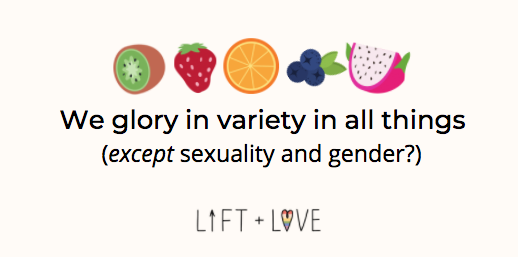
Do we glory in variety in all things, EXCEPT sexuality & gender?
With the wide variety of characteristics from individual to individual, why are we so surprised there is a variety or a spectrum in sexuality and in gender?
There is a misconception that people choose to be LGBTQ. This is some seriously OLD school nonsense.
Being LGBTQ is not something that a person can turn on or turn off. It’s not born out of curiosity, pornography, depravity, or rebellion.
With the wide variety of characteristics from individual to individual, why are we so surprised there is a variety or a spectrum in sexuality and in gender?
Within a nuclear family, height, body type, eye color, disposition, intellect, hair texture & color, ability to keep or grow hair, mental health, finger length, foot size, ability to dunk, risk aversion, taste, birth defects, thoughtfulness, and fertility are some of the thousands of characteristics that make each of us unique and amazing. None of these things can be chosen.
Why do we expect sexuality and gender to be something we can change?
We glory in variety in all things, except sexuality and gender?
I’m pretty sure LGBTQ human beings did not take our Heavenly Parents by surprise. We should not be surprised by the concern and protective love they have for THEIR LGBTQ children. Particularly as they are so misunderstood and mistreated.
Heavenly Father desires that EACH of His creations grows and thrives in its particular sphere.
Science is getting closer to understanding how sexual and gender variety comes to be. The latest research on homosexuality, for example, points to genetics and gestational factors. As we come to understand how natural it is to have a percentage of humans fall into one or more of the LGBTQ categories, we need to strive to understand more fully the Father’s plan for His unique LGBTQ children.
As members of the Church of Jesus Christ of Latter-day Saints, WE understand the miracle of continuing revelation and further light and knowledge.
Let us pray for that very light to shine on our LGBTQ members. WE can bring them out of the shadows into the healing light of the Savior’s love and our embracive community.
With love, we can do so much more than we think we can. ❤️
-Allison